
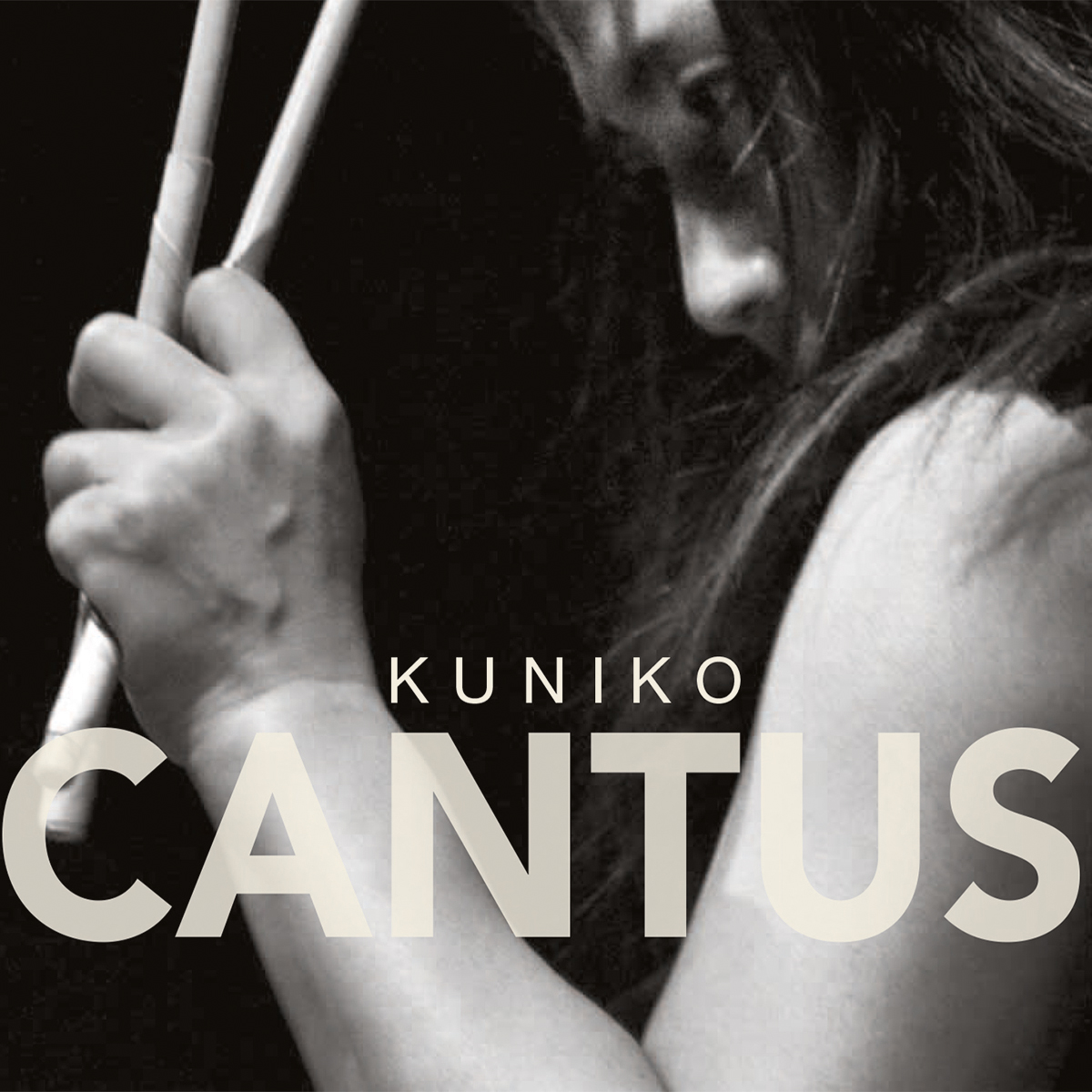
CANTUS
KUNIKO’s eagerly awaited second album includes world premiere recordings of the percussionist’s new arrangements of popular works by contemporary composers Arvo Pärt, Steve Reich and Hywel Davies.
Best of 2013 Readers’ Choice – The Washington Post ‘Several people on my list are already getting copies [of this] insanely beautiful disc.’ by Joshua Cheek
Best Recording Award – 26th MPCJ Music Award (Music Pen Club Japan)
CANTUS (LINN CKD432)
- Fur Alina arr. for Vibraphone and Crotales | Composer Arvo Pärt | Soloist KUNIKO | Arranger kuniko kato | 04:00
- New York Counterpoint arr. for Marimba | Composer Steve Reich | Soloist KUNIKO | Arranger kuniko kato | 11:14
- Cantus in Memory of Benjamin Britten arr. for Marimba | Composer Arvo Pärt | Soloist KUNIKO | Arranger kuniko kato | 06:27
- Fratres arr. for Marimba and Vibraphone | Composer Arvo Pärt | Soloist KUNIKO | Arranger kuniko kato | 08:10
- Purl Ground | Composer | Hywel Davies | Soloist KUNIKO | 11:24
- Spiegel im Spiegel arr. for Marimba and Bells | Composer Arvo Pärt | Soloist KUNIKO | Arranger kuniko kato | 10:25
CANTUS (LINN CKD432)
KUNIKO’s debut ‘kuniko plays reich’ was acclaimed by the media becoming Linn’s bestselling album of 2011. Her follow up recording, ‘cantus’, features six pieces arranged for five octave marimba or vibraphone, each chosen to fully demonstrate the colours, depth and dynamics of the instrument. The arrangements and recording have been made with supervision by the original composers: Arvo Pärt, Steve Reich and Hywel Davies.
KUNIKO gave the world premiere performance of Reich’s New York Counterpoint version for marimba in New York in 2012. KUNIKO won praise from the composer himself who stated: ‘Kuniko Kato is a first rate percussionist.’
The simplicity and beauty of Arvo Pärt’s music has won the composer many fans. In turn Pärt is a fan of KUNIKO’s arrangements having approved the new versions premiered on this album. KUNIKO has arranged four of his best-loved pieces including Cantus, a fitting tribute to Benjamin Britten in 2013, his 100th anniversary year.
Purl Ground is an original piece written by British composer Hywel Davies, which KUNIKO premiered at the Cheltenham Festival in 2011 to critical acclaim. The piece is composed for solo marimba and makes excellent use of both tremolo and pianissimo effects.
Booklet Notes
After the success of my first album, kuniko plays reich, I wanted to make minimalist music more accessible. This is what inspired me to make this recording. On this album, I experimented with the sounds that could be created by percussive instruments, specifically the variety of voices that could be created on the marimba. The result is a recording that showcases the colours, depth and dynamics of the marimba in a way never heard before. Each of the tracks has been kept as close as possible to the original recording session so as to preserve its sense of ethereality and organic acoustic performance.
As a child learning piano, I found myself held back by my small hands. As I grew older, I discovered the marimba and instantly knew this was the instrument for me. Despite that initial enthusiasm, after a while I began to feel limited by what I perceived as the marimba’s constraints and moved away from it temporarily, not playing a single note for a number of years. Therefore it is with a great sense of accomplishment that as I continue my career as a soloist, every day I continue to surprise myself with the breadth of tone of which the marimba is capable. I now consider it the most indispensable instrument in my musical life.
My previous recording which features three of Steve Reich’s counterpoints got me thinking about how I could arrange his New York Counterpoint for marimba. My performance of New York Counterpoint was completed only after much thought and deliberation, and after numerous live performances.
New York Counterpoint is among my favourite pieces and it is also one of Reich’s most popular compositions. With this new recording, I have recorded all of Reich’s counterpoints. Once more, I would like to offer my sincere thanks to Steve Reich for his advice and supervision as I arranged this beautiful piece.
With Reich’s minimalism in my mind, I began to think about all of the other composers in this field. I found myself consistently being drawn into the world of another accomplished minimalist composer featured on this album: Arvo Pärt. His music is beautifully simple and comprises solemn, tender and sorrowful sounds. Whilst living in Belgium more than ten years ago, I found myself listening to his music in the quiet of night just as it was beginning to reach popularity. I rediscovered Pärt’s music as I was working on Cantus. As I immersed myself in his musical world, I felt an unalterable sense of pleasure and found myself deeply moved.
The pieces I have selected to perform for this album will be familiar to anyone who knows Pärt’s repertoire. I chose not only pieces composed for percussion instruments but I also chose compositions arranged for multiple instruments. I believe that Pärt’s music has incredible qualities: the ability to convey the entire scope of human emotion as well as the immense force and harshness of the natural world in which we exist. As we delve deep into Pärt’s world of minimalism, we are able to discover melodies and harmonies which affect both the heart and body profoundly.
Artistically, interpreting the raw emotion of each composition using only percussion instruments was a huge challenge whilst recording this album. I have taken every step to ensure that each track on this recording is as pure and as close to the original composition as possible by closely analysing the performance practices, recording locations and editing processes that I used. I am extremely grateful to Arvo Pärt for his generosity and support as I worked on these arrangements of his compositions for percussion instruments.
Contemporary music is often regarded as ‘difficult’ . However, it is my hope that you will find this music accessible; I hope that you enjoy these performances, the compositions themselves, and also the differences between my arrangements and the original compositions. To encounter great music is a true joy and a great adventure; I hope you will discover this pleasure whilst listening to these beautiful pieces by these great composers.
Finally I would like to extend my most sincere thanks to the producers and engineers who have been so generous and dedicated to the long journey that resulted in the completion of this album, as well as to every company and individual person who has supported me in this enterprise.
Spiegel im Spiegel and Fratres
BankART 1929 NYK Studio is located in a warehouse district which overlooks Yokohama port. This is where the Arvo Pärt section of the project started.
Rather than being a well-equipped recording studio or a concert hall, BankART 1929 NYK Studio is an old warehouse constructed of thick concrete walls which is used as a performing arts space. It is one of very few places in Japan where I could achieve the levels of resonance required, unlike Europe which is filled with large, old buildings such as churches that have acoustics that can be experimented with. I loved the extreme echoing sounds I was able to create in this space.
Ultimately, the takes I chose from BankART 1929 NYK Studio were the main section consisting of three chords from the solo parts of Fratres and the entire recording of Spiegel im Spiegel. The acoustics at this venue allowed me to create sounds similar to the traditional suikinnkutsu (a Japanese musical instrument that creates dripping sounds), resulting in each note spreading across the performance space, delicately lingering in the air.
Für Alina
Situated in the mountains near Nagano is the small church where I decided to record Für Alina. Every sound resounded in the church as I recorded in the cold, ancient structure and the soft sounds of the ladybirds travelled through the stained glass windows. It was in this unique environment that Alina was born.
Cantus and New York Counterpoint
My greatest challenge during this project was to record New York Counterpoint and Cantus in Memory of Benjamin Britten. While it was necessary to use a studio to overdub both of these pieces, I needed the original recording to possess an airy, ethereal quality which would have been impossible to achieve inside a recording studio. Ultimately, I chose to record at Lake Sagami Hall; this concert hall has a very neutral character and provides a well-balanced acoustic reverberation.
In New York Counterpoint I wanted to highlight the waves of sound that appear at the beginning of the composition (and other various sections). I also wanted to express the movement of each note in the second movement with a softer marimba sound in an effort to mimic the sounds created by the original instrument: the clarinet.
I was keen to find a way of incorporating the sounds of the clarinet into my arrangements without resorting to artificial or electronic techniques. Luckily, I was able to find a way to organically replicate these distinctive sounds. I used the entire five octave range of the marimba made entirely out of wood in conjunction with specific mallets and striking methods: bass clarinet tonguing techniques were replicated by strikes with a large rubber mallet (commonly used with the balafon in Africa) and the xylophone-like high notes in the third movement were recreated using the core of the marimba mallet.
In Cantus I avoided the conventional tremolo on the marimba and instead I sandwiched the bars between the mallets. I played the whole piece at pianissimo, without changing my dynamics. On the recording, when you hear the dynamics increase I am adding one of the orchestral parts. With over 29 orchestral parts and the additional microphones required for this recording, we had over 200 tracks by the end of the recording!
Cantus is a piece of incredible imagery: alternately powerful and overwhelming like an organ and then soft and prayer-like. It inspires visions of the deep, dominant forces within the earth juxtaposed with the gentleness of rain falling from the sky.
Purl Ground
Another highly important piece is Purl Ground which was also recorded at Lake Sagami Hall. Written by the renowned British composer Hywel Davies, this is the only piece on the recording originally scored for solo marimba. Purl Ground was composed and premiered in Canada in 2003. Its British premiere took place in 2011 at the Cheltenham Music Festival and was performed by myself. Discovering this beautiful piece was a truly pleasant surprise for me. It is a fantastic minimalist composition that has become a favourite in my solo performance repertoire.
Purl Ground explores the quiet affinity between the bottom octave and the half-way point of the marimba. Beautifully written, featuring tremolo sounds that never surpass pianissimo, Purl Ground is reminiscent of a chorale, structured with a sequence of twelve chords and a special harmonic overtone that skilfully maintains a sotto voce dynamic throughout the piece. Purl Ground makes full use of the depth of the modern five octave marimba. Towards the end of the piece, a resonating sound, like a big bell, rings out endlessly. Achieving Davies’ desired hypnotic ‘hum’ in this recording required countless hours of rehearsals and recording takes. This piece is deeply evocative; when I close my eyes, I am greeted by visions of sunlight dancing on water, gently changing colour.
© kuniko kato, 2013
Recording Info:
Recorded at The Lake Sagami Hall, Kanagawa, Japan, BankART 1929 NYK Studio, Yokohama, Japan, Church at Hotaka View Hotel & Resort, Nagano, Japan.
All tracks are recorded at 192kHz / 24bit audio.
Recording Engineer: Yuji Sagae & Junichiro Hayashi
Produced and Mixed by Yuji Sagae & Kuniko Kato
Mastering: Bastiaan Kuijt, BK Audio, NL
Executive Producer: Philip Hobbs at Linn Records
Photography: Mario Boccia, Michiyuki Ohba
Designed by: gmtoucari.com
Production Coordination: Kim Campbell at Linn Records
Special thanks: Seiji Murai, Tsuyoshi Yasukawa, Michio Akiyama, Anna Suzuki, Yoichi Toishi, Yumiko Tanaka, Natsuki Urushibata, Takafumi Oike, Makoto Ohara, Shoichi Kado, Akira Fukada, Seigen Ono, Yasushi Tanaka, Norio Sato, Taimi Paves, Eric Marinitsch, Aygün Lausch, Andy Ito and Cathy Jefferies at Linn Records, ADAMS, Pearl, RME-Synthax Japan, MI-7Japan, Steinberg, CottaTV, Sanken, Fujitsu-Ten Corp, Saito, Lake Sagami Hall, BankART 1929, Hakuju Hall, Hotaka View Hotel, Boosey & Hawkes, Universal Edition AG, Arvo Pärt Center and Istituto Giapponese di Cultura in Roma.
Credits:
All original music and supervision by Arvo Pärt, Steve Reich and Hywel Davies.
Cantus in Memory of Benjamin Britten, Für Alina, Fratres, Spiegel im Spiegel, Arrangement for percussion instruments by Kuniko Kato ©Copyright 2013 by Universal Edition A.G., Wien
New York Counterpoint ©Copyright 1987 by Hendon Music, Inc.
This arrangement made by permission of Boosy & Hawkes Music Publishers Ltd.

Download 192k/24bit Studio Master from Linn.